
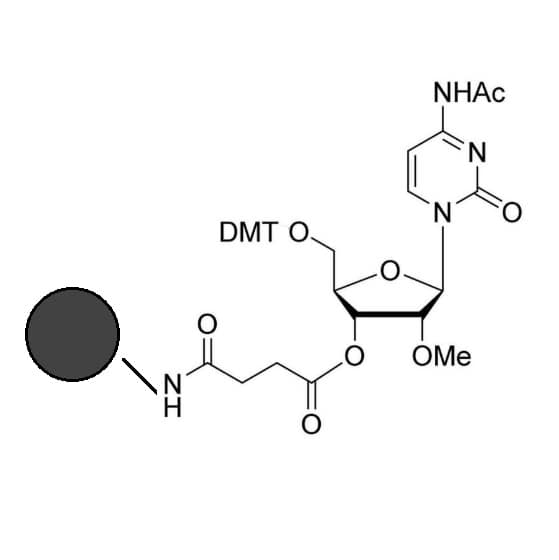
What is 2′-OMe rC(Ac)?
2′-OMe rC(Ac) is a high-performance building block essential for the chemical synthesis of RNA and modified oligonucleotides. This abbreviation represents 2′-O-methyl protected ribo-cytidine featuring an N4-acetyl protecting group.
2′-OMe (2′-O-methyl): Indicates a methyl modification at the 2′-hydroxyl position of the ribose sugar. This modification is a cornerstone in RNA therapeutics, significantly enhancing nuclease resistance, metabolic stability, and binding affinity to target mRNA.
rC (ribo-cytidine): Refers to the RNA nucleoside containing cytosine as the nucleobase.
Ac (acetyl): Represents the acetyl protecting group attached to the N4 amino position of cytosine. Acetyl is the preferred protection for cytosine in many modern synthesis protocols due to its rapid deprotection kinetics and high stability.
2′-O-methyl modified cytidine is widely integrated into siRNA, antisense oligonucleotides (ASO), and CRISPR/Cas9 guide RNA (gRNA) to improve the pharmacological profile of the synthetic RNA.
Role of the Ac Protecting Group
During automated oligonucleotide synthesis, the N4 amino group of cytosine is highly reactive and must be shielded to prevent branching or side reactions during the phosphoramidite coupling cycles.
Side Reaction Prevention
The acetyl (Ac) group provides robust protection for the cytosine base, ensuring high coupling efficiency and sequence fidelity.
Efficient Deprotection
Unlike some bulkier protecting groups, the Ac group is efficiently removed during the standard cleavage and deprotection step (typically using aqueous ammonia or AMA). This restores the native 2′-O-methyl cytidine structure without requiring extended incubation times, minimizing potential RNA degradation.
Applications of 2′-OMe rC(Ac)-CPG
2′-OMe rC(Ac)-CPG serves as the specialized solid support for initiating oligonucleotide synthesis when the 3′-terminal nucleotide of the sequence is a 2′-O-methyl cytidine.
Typical Applications
siRNA Synthesis: Ideal for strands where the 3′ terminal nucleotide is 2′-OMe C.
Antisense Oligonucleotides (ASO): Supporting various designs including gapmers and fully modified sequences.
CRISPR gRNA / sgRNA: For high-purity chemical synthesis of guide RNA components.
Therapeutic RNA Research: Enabling the production of modified RNA for drug discovery and molecular diagnostics.
Advantages of Co-Polymer Coated 2′-OMe rC(Ac)-CPG
Poresyn Solutions’ co-polymer coated CPG solid support is engineered to overcome the limitations of traditional supports, specifically for industrial-scale and GMP-compliant production.
Ultra-High Loading Capacity
The advanced co-polymer coating allows for 3× higher loading capacity compared to standard functionalized CPG. This allows for significantly higher oligonucleotide yield per gram of support, maximizing synthesizer throughput.
High Crude RNA Purity
The chemically inert co-polymer layer offers superior resistance to acidic deblocking and basic deprotection reagents. This results in superior crude purity typically over 80% even for long sequence RNA, simplifying downstream HPLC or PAGE purification.
Rigid Non-Swelling Structure
Unlike polymer-based resins (e.g., polystyrene), our coated CPG maintains a rigid, constant volume across all organic and aqueous solvent transitions. This ensures consistent flow rates and optimal mass transfer during coupling and oxidation.
No Silica Particle Contamination
The proprietary coating encapsulates the CPG surface, preventing the shedding of “silica fines” during cleavage. This eliminates column clogging and backpressure issues, which are critical during large-scale manufacturing.
More Resources
rA(Bz) 2’OMe Co-Polymer Coated CPG controlled pore glass
rC(Bz) 2’OMe Co-Polymer Coated CPG controlled pore glass
rG(ibu) 2’OMe Co-Polymer Coated CPG controlled pore glass


Reviews
There are no reviews yet.