
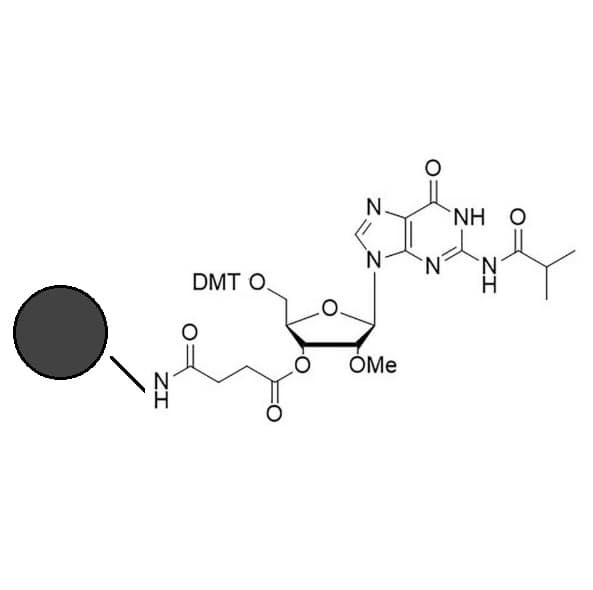
1. What is 2′-OMe rG (ibu)?
2′-OMe rG (ibu) is a chemically modified riboguanosine nucleoside used as a fundamental building block in advanced nucleic acid synthesis.
2′-O-Methyl (2′-OMe) Modification: The ribose sugar is methylated at the 2′ position. This modification significantly enhances the nuclease resistance and binding affinity of the resulting oligonucleotide, making it a staple in therapeutic RNA.
rG (ibu) Protection: The “ibu” stands for isobutyryl, a specialized protecting group attached to the guanine base. This ensures the nucleobase remains chemically stable and free from side reactions during the intense phosphoramidite synthesis cycles.
2. Applications of 2′-OMe rG (ibu)-CPG
In traditional oligonucleotide synthesis, the 2′-OMe rG (ibu)-CPG serves as the “solid foundation” or starting point. When a sequence ends with a 2′-OMe Guanosine at the 3′ terminus, this pre-loaded CPG is used to initiate the chain.
Therapeutic RNA Synthesis: Critical for producing siRNA, Antisense Oligonucleotides (ASOs), and Aptamers, where 2′-OMe modifications are required to prevent rapid degradation in the human body.
mRNA & gRNA Production: Used in the synthesis of components for CRISPR-Cas9 gene editing, specifically where high-purity 3′ modifications are necessary for structural stability.
Diagnostic Probes: Essential for creating highly stable molecular beacons and PCR probes that require resistance to enzymatic digestion.
3. Advantages of Poresyn Co-Polymer Coated 2′-OMe rG (ibu)-CPG
While traditional functionalized CPG often suffers from low loading and fragile physical structures, our Co-polymer Coated (Polystyrene + CPG) architecture redefines the standards for GMP-scale manufacturing.
| Feature | Traditional Functionalized CPG | Poresyn Co-Polymer Coated CPG |
| Loading Capacity | Limited (approx. 15–90 μmol/g) | 3× Higher (50- 240 μmol/g) |
| Purity (FLP) | Often ~60% Crude Purity | >80% Crude Purity |
| Physical Stability | Prone to “fines” (breaking), causing backpressure | Ultra-stable; No silica contamination or clogging |
| A260 Output | Standard R&D output | 3× Increase in total OD yield |
| Chemical Resistance | Sensitive to harsh deprotection | High resistance to both acidic and basic conditions |
| Cost Efficiency | High downstream purification costs | Saves 30%+ on purification expenses |
PoresynSolutions‘ Co-Polymer Coated 2′-OMe rG (ibu)-CPG is engineered for the industrial-scale GMP production of API oligonucleotides. By combining the rigid, non-swelling nature of CPG with the high-activity environment of our proprietary resin coating, we enable biotech companies to achieve unprecedented mass-output and batch-to-batch consistency without changing their existing hardware setups.
More Resources
rA(Bz) 2’OMe Co-Polymer Coated CPG (Controlled Pore Glass)
rC(Ac) 2’OMe Co-Polymer Coated CPG (Controlled Pore Glass)
rC(Bz) 2’OMe Co-Polymer Coated CPG (Controlled Pore Glass)


Reviews
There are no reviews yet.