
1. Product Overview
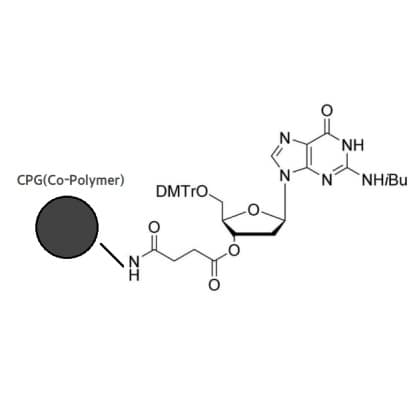
Product Name: dG(iBu)-CPG (Co-Polymer Coated, HL-CPG)
Product Positioning:
Designed for the incorporation of unmodified dG at the 3′ end of oligonucleotides.
Suitable for the synthesis of challenging, long, and modified oligonucleotides.
Compared with traditional dG(iBu)-CPG, our dG(iBu)-CPG (Co-Polymer) features a new CPG solid support architecture (polystyrene + crosslinked CPG). In addition to high loading and high purity, this new support provides better compatibility with modified monomers and improved batch-to-batch stability.
Product Form: Powder
Product Color: White powder
Packaging: Glass bottle
2. What is dG(iBu)?
2.1 Chemical Identity of dG(iBu)
Full Name: 2′-Deoxyguanosine, N²-isobutyryl protected
Molecular Formula: C11H15N5O5 (for reference/SEO purposes)
Nucleoside Structure:
Base: Guanine (G)
Sugar: 2′-Deoxyribose
Protecting Group: N²-isobutyryl (iBu) – protects the exocyclic amino group of G to prevent side reactions, improve coupling efficiency, and stabilize DNA synthesis
2.3 Role of dG(iBu) in Oligonucleotide Synthesis
Serves as a 3′-terminal nucleoside for DNA oligonucleotide synthesis
Positioned at the 3′ end of the solid support, enabling stable and efficient incorporation of guanine during solid-phase synthesis
3. Application Scenarios of dG(iBu)-CPG
dG(iBu)-CPG is primarily used for the synthesis of modified or unmodified DNA oligonucleotides, including DNA or DNA-like structures (such as gapmers or phosphorothioate backbone oligos). This solid support is particularly suitable for ASO drugs, typically 15–25 nt in length. In long ASO sequences, G-rich regions are prone to side reactions, so using dG(iBu)-protected CPG helps improve both purity and yield.
3.1 Example Applications
| Application | Use Case | Typical Length | Features |
|---|---|---|---|
| ASO Drugs | Spinraza® (nusinersen) – SMA, Gapmer structure; Mipomersen – familial hypercholesterolemia | 15–25 nt | G-rich sequences require N²-isobutyryl protection to prevent side reactions and improve yield |
| DNA Probes / Diagnostic DNA Oligonucleotides | PCR / qPCR, FISH, genetic testing | 20–60 nt | DNA probes containing G residues in long sequences benefit from dG(iBu)-CPG to enhance purity and coupling efficiency |
| DNA Primers | PCR / qPCR, NGS library construction | 30–60 nt | G-rich primers require dG(iBu)-CPG as the 3′ solid support during synthesis |
| Gene Editing DNA Templates (non-RNA) | In vitro PCR, in vitro transcription (IVT) templates, or modified DNA oligos | >100 nt | Long DNA sequences require dG(iBu)-CPG to improve coupling efficiency and synthesis stability |
4. Advantages of Using dG(iBu)-CPG
During DNA synthesis, the following challenges are commonly encountered, which make dG(iBu)-CPG necessary:
- Decreased coupling efficiency related to G bases
- Accumulated stepwise yield loss in long-chain synthesis
- Reduced crude oligo purity
- Abnormal DMT deprotection
- Support failure in highly modified systems
5. Why Poresyn Solutions dG(iBu)-CPG
Even when using traditional dG(iBu)-CPG, DNA oligonucleotide synthesis often faces several issues. Most DNA oligos are short sequences, but the main problems include low FLP output due to insufficient loading capacity, and purity rarely exceeding 60%, which places a heavy burden on downstream purification.
Poresyn Solutions’ new patented solid support technology – polystyrene + CPG crosslinked technology is designed to address these pain points.
5.1 High-Loading HL-CPG Platform
- Optimized co-polymer coating technology: Provides structural stability, unlike traditional resins that swell. Our support ensures no swelling, no CPG fragments, eliminating silicon contamination or blockages in synthesizer tubing and maintaining production safety.
- Higher and more stable nucleoside loading: Ultra-high loading, up to 240 μmol/g, approximately three times higher than conventional CPGs.
- High crude oligo purity: Up to 80%, thanks to the support’s strong resistance to chemical reagents and solvents during synthesis and subsequent treatment.
- Batch-to-batch consistency: Ensures stable industrial-scale oligo production.
5.2 Excellent Chemical & Mechanical Stability
- Resistant to strong base, oxidation, and sulfurization conditions
- Suitable for prolonged automated synthesizer operation
5.3 Designed for GMP & Scale-Up
- Supports synthesis from µmol to mmol scale
- Suitable for CDMO / CMO scale-up requirements
- Strong process transferability for industrial applications
5.4 Cost and Time Efficiency
- Significantly reduces production time, labor costs, and purification expenses
6. Quality Control & Manufacturing Standards
Raw Material Control
Our CPG raw materials are produced strictly according to ISO standards. Key physical and chemical parameters such as pore volume, pore size, and specific surface area are tightly controlled to ensure high batch-to-batch consistency. Each batch undergoes rigorous testing using precision instruments, including BET nitrogen adsorption analyzers and laser particle size analyzers, to verify pore size distribution, surface area, and particle uniformity.
6.1 QC Testing
After production, our co-polymer coated CPG undergoes comprehensive quality control testing. This includes measurements of nucleoside loading, visual inspection, swelling assessment, and verification in actual DNA oligonucleotide synthesis reactions. These tests ensure that each batch performs reliably, achieves the designed loading capacity, and maintains synthesis stability even in high-load or heavily modified oligonucleotide applications.
6.2 Batch Traceability
Every batch is fully traceable, with complete records from production and testing to shipment. This ensures that customers receive products with known batch histories, facilitating technical support, after-sales service, and reliable industrial-scale or GMP applications.


Reviews
There are no reviews yet.