
1. Product Overview
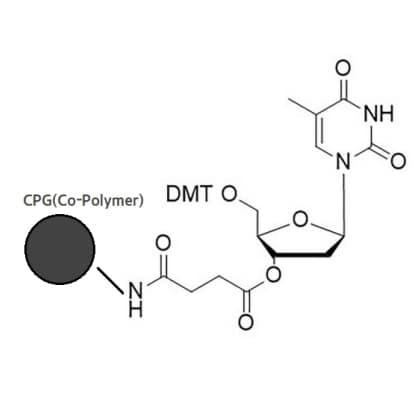
Product Name: dT-CPG (Co-Polymer Coated, HL-CPG)
Product Positioning:
Designed for the incorporation of unmodified dT at the 3′ end of oligonucleotides.
Suitable for the synthesis of challenging, long, and modified DNA oligonucleotides.
Compared with traditional dT-CPG, our dT-CPG (Co-Polymer) features a new CPG solid support architecture (polystyrene + crosslinked CPG). In addition to high loading and high purity, this new support provides better compatibility with modified monomers and improved batch-to-batch stability.
Product Form: Powder
Product Color: White powder
Packaging: Glass bottle
2. What is dT-CPG?
dT is one of the most stable nucleobases in DNA. Its base contains a methyl group at the 5-position (5-CH₃) and is chemically inert, meaning it does not participate in undesired side reactions. Unlike dC or dG, thymine has no reactive exocyclic amino groups, making it naturally stable during DNA synthesis.
As a result, during solid-phase synthesis, dT does not require additional protection and can be directly incorporated into the oligonucleotide chain.
2.1 Chemical Identity of dT-CPG
Full Name: 2′-Deoxythymidine, protected with a suitable base-protecting group (T-CPG)
Molecular Formula: C10H14N2O5 (for reference/SEO purposes)
Nucleoside Structure:
Base: Thymine (T)
Sugar: 2′-Deoxyribose
Protecting Group: Standard protecting group for thymine – shields reactive sites during DNA synthesis to prevent side reactions, improve coupling efficiency, and stabilize the synthesis process
2.2 Role of dT-CPG in Oligonucleotide Synthesis
Serves as the 3′-terminal nucleoside for DNA oligonucleotide synthesis.
Positioned at the 3′ end of the solid support, enabling stable and efficient incorporation of thymine during solid-phase synthesis.
3. Application Scenarios of dT-CPG
dT-CPG is primarily used for the synthesis of unmodified DNA oligonucleotides. This solid support is suitable for a wide range of DNA sequences, including ASO drugs, DNA probes, primers, and long DNA templates. Thymine (T) is chemically stable, so dT-CPG allows efficient incorporation without additional base protection.
3.1 Example Applications
| Application | Use Case | Typical Length | Features |
|---|---|---|---|
| ASO Drugs | Example ASO DNA sequences | 15–25 nt | Thymine is stable, no additional protection required; suitable for G/T-balanced ASO sequences |
| DNA Probes / Diagnostic DNA Oligonucleotides | PCR / qPCR, FISH, genetic testing | 20–60 nt | dT-CPG allows efficient incorporation of thymine in long sequences, improving coupling efficiency and purity |
| DNA Primers | PCR / qPCR, NGS library construction | 30–60 nt | Stable thymine incorporation as 3′-terminal nucleoside, ensuring high synthesis reliability |
| Gene Editing DNA Templates (non-RNA) | In vitro PCR, in vitro transcription (IVT) templates, or modified DNA oligos | >100 nt | Long DNA sequences can incorporate thymine efficiently, ensuring stable synthesis and high yield |
3.2 Some Existing ASO drugs suitable for using our co-polymer coated dT-CPG
| Drug Name | Brand | Key Features | Description / Indication |
|---|---|---|---|
| Fomivirsen | Vitravene | First-generation phosphorothioate single-stranded DNA ASO (21 nt) | Used for cytomegalovirus retinitis (earlier approval) |
| Mipomersen | Kynamro | DNA-like gapmer ASO (20 nt) | Used for familial hypercholesterolemia |
| Inotersen | Tegsedi | Phosphorothioate ASO (20 nt) | Used for hereditary transthyretin-mediated amyloidosis (hATTR) |
| Eplontersen | Wainua | Gapmer ASO (DNA-like) | Used for hereditary transthyretin amyloidosis (ATTRv-PN) |
4. General Advantages of Using dT-CPG
During DNA synthesis, the following challenges are commonly encountered, which make dT-CPG a suitable choice:
Low coupling efficiency in long-chain DNA sequences
Accumulated stepwise yield loss during extended synthesis
Reduced crude oligo purity
Occasional DMT deprotection issues
Support instability in highly modified or challenging sequences
5. Why Poresyn Solutions dT-CPG
Even when using traditional dT-CPG, DNA oligonucleotide synthesis can face several issues. Common challenges include low FLP output due to insufficient loading capacity, reduced crude oligo purity, and stability concerns during long-chain or highly modified DNA synthesis.
Poresyn Solutions’ patented co-polymer coated solid support (polystyrene + crosslinked CPG) is designed to address these challenges, ensuring high loading, purity, and reliable industrial-scale performance.
| Feature | Description |
|---|---|
| High-Loading HL-CPG Platform | Optimized co-polymer coating ensures structural stability with no swelling and no CPG fragments. Ultra-high nucleoside loading up to 240 μmol/g, ~3x higher than conventional CPGs. High crude oligo purity (up to 80%) and batch-to-batch consistency for industrial-scale synthesis. |
| Chemical & Mechanical Stability | Resistant to strong bases, oxidation, and sulfurization. Suitable for prolonged automated synthesizer operation. |
| GMP & Scale-Up | Supports synthesis from µmol to mmol scale. Ideal for CDMO / CMO scale-up requirements with strong process transferability. |
| Cost and Time Efficiency | Significantly reduces production time, labor costs, and purification expenses. |
| Quality Control & Manufacturing Standards | CPG raw materials are ISO-compliant. Key parameters (pore volume, pore size, specific surface area) are tightly controlled and verified using BET nitrogen adsorption analyzers and laser particle size analyzers. Each batch undergoes QC testing (loading, appearance, swelling, and performance in actual synthesis) and full batch traceability is maintained. |


Reviews
There are no reviews yet.