
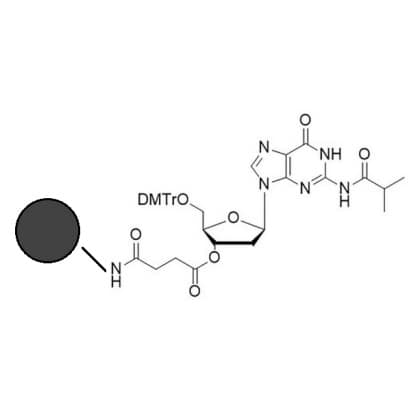
What is rG(iBu)?
rG(iBu) is a commonly used abbreviation in nucleic acid chemical synthesis.
Its full name is N2-Isobutyryl-guanosine.
r (ribo): Indicates ribose, meaning this is an RNA component rather than DNA (which would be denoted as dG).
G (Guanosine): Refers to guanosine, with guanine as the nucleobase.
iBu (isobutyryl): Refers to the isobutyryl protecting group attached to the N2 position of guanine.
About the (iBu) Protecting Group
During RNA oligonucleotide synthesis, the exocyclic amino group (–NH₂) at the N2 position of guanine is chemically reactive and may participate in unwanted side reactions during coupling, oxidation, or sulfurization steps.
To prevent these side reactions, the N2 position is protected with an isobutyryl (iBu) group during solid-phase synthesis.
After completion of RNA chain assembly, standard deprotection conditions (commonly aqueous ammonia or AMA) remove the isobutyryl group, restoring the native riboguanosine structure.
Thus, rG(iBu) ensures:
Reliable base protection during synthesis
High coupling efficiency and sequence fidelity
Clean and controlled deprotection to natural rG
The isobutyryl group is widely used in RNA synthesis due to its balanced stability under synthesis conditions and efficient removal during deprotection.
Applications of rG(iBu)-CPG
rG(iBu)-CPG is a member of our RNA modified CPG familiy, it is selected whenever the 3′-terminal base of the RNA sequence is guanosine.
siRNA
When the 3′-terminal nucleotide of either the sense or antisense strand is guanosine (G), rG(iBu)-CPG ensures precise incorporation of riboguanosine at the 3′ end, maintaining duplex accuracy and structural integrity.
CRISPR gRNA / sgRNA
For chemically synthesized guide RNAs, if the 3′ terminus begins with guanosine, rG(iBu)-CPG serves as the appropriate starting solid support.
It is also suitable for chemically synthesized RNA fragments used in ligation workflows or transcription-based assembly processes.
mRNA Fragments
In chemically synthesized RNA fragments for mRNA applications, rG(iBu)-CPG ensures:
A defined riboguanosine at the 3′ end
Compatibility with 2′-modifications
Stability during phosphorothioate chemistry
Overall, rG(iBu)-CPG provides a classical and highly reliable guanine protection strategy for complex RNA synthesis.
Benefits of Co-Polymer Coated rG(iBu)-CPG in GMP-Scale RNA Production
Ultra-High Loading Capacity
Poresyn Solutions’ co-polymer coated CPG solid support delivers 3–6× higher loading than conventional functionalized CPG solid supports, significantly increasing RNA oligonucleotide output per batch.
Typical loading levels:
500 Å: 200–240 μmol/g
1000 Å: 100–150 μmol/g
2000 Å: 40–80 μmol/g
This makes it especially advantageous for long RNA synthesis (>100 nt) at GMP industrial scale.
Recommended Pore Size Selection
| Pore Size | Optimal Oligo Length | Capabilities |
|---|---|---|
| 500–600 Å | 20–35 nt | Ideal for short to medium-length oligonucleotides. Suitable for high-yield therapeutic oligo production. |
| 1000 Å | 50–80 nt | Designed for medium-length and moderately modified oligonucleotides. Provides balanced loading and diffusion efficiency. |
| 1500 Å | 75–150 nt | Suitable for long oligonucleotides and complex modified sequences. Optimized for improved synthesis efficiency of extended chains. |
| 2000 Å | 100–200 nt | Recommended for very long RNA/DNA synthesis. Ideal for CRISPR gRNA and long-chain GMP-scale applications. |
Protection Strategies and Support Selection
| Products | 2’-OH Protection | Notes |
|---|---|---|
| Prime CPG | TBDMS | Classic RNA chemistry. |
| 2’-OAc Prime CPG | O-Acetyl | Cleaves to give 2,3’-diol, avoiding the possibility of 2’ to 3’ migration sometimes seen with TBDMS. |
| Co-polymer coated CPG | Various options | Features a specialized polymer coating on the glass surface to enhance physical durability and chemical stability. It reduces “fines” (particle breakdown) and ensures highly uniform loading, making it ideal for high-throughput or large-scale synthesis. |
| Others | TBDMS as standard | Classic RNA chemistry. |
High Crude RNA Purity
The co-polymer coating demonstrates excellent resistance to:
Acidic detritylation conditions
Basic deprotection
Organic solvents used in coupling
Resulting in:
>80% crude RNA purity
This significantly reduces purification burden and improves overall process efficiency.
Stable Physical Structure
Unlike traditional polystyrene-based resins that swell in organic solvents, the rigid CPG core:
Maintains dimensional stability
Ensures consistent flow characteristics
Prevents bed compression during large-scale synthesis
This stability is critical for reproducible GMP RNA API manufacturing.
No Silica Shedding Risk
The co-polymer coating tightly stabilizes the CPG surface, minimizing:
Silica particle shedding
Column clogging
Backpressure increase
This ensures reliable synthesis of long and complex RNA oligonucleotides, including:
siRNA
CRISPR gRNA
Long-chain mRNA fragments
Summary
Co-polymer coated rG(iBu)-CPG combines classical isobutyryl guanine protection chemistry with next-generation high-loading CPG architecture, enabling:
3–6× higher loading capacity
80% crude RNA purity
Superior structural stability
GMP-compatible industrial-scale RNA oligonucleotide production



Reviews
There are no reviews yet.