Poresyn Solutions Hyper Link CPG 2'-F CPG

Poresyn Solutions’ 2′-F Modified HL-CPG offer:

Co-Polymer Coated CPG linked with 2′-F Modified Nucleic acid monomer , providing super high loading and outstanding UV purity. 

Small MOQ

We support small MOQs, starting from 10 g, for the Universe linker type.

Tailored Solutions

No matter what kind of linker you need, we can fulfill unique requests.

Free Sample For Test

Providing small sample of our HL-CPG with Unylinker for testing without charge

Free Delivery

Free air shipping, typically, the things arrive within seven days.
2'-F CPG (Co-Polymer)

2'-Fluoro Modified CPG (Co-Polymer)

Addrssing GMP Scale Oligonucleotide Production

Currently, the CPG solid support provides poor loading capacity, particularly for big pore size types, such as 1000A, 2000A, etc., to address industrial scale production issues. The OD value is frequently so low that it stays around less than 100 (based on 100nt), which makes mass manufacture of the oligonuceltide medications unfeasible. In addition, the loading capacity is so little that the FLP (full length product) takes a low percentage of the entire synthesis result. High loading and high purity are made feasible by Poresyn Solution’s HL-CPG (co-polymer coated CPG), which allows us to increase the OD value to the thousands level and save significant purifying costs. This allows us to produce long chain oligos on a GMP scale.

Why HL-CPG Has Super Higher Loading Capacity

At Poresyn Solution, we maintain the coating thickness at the nanoscale scale by covering the surface of controlled pore glass with an incredibly thin layer of resin, so thin that it hardly changes the pore size (for instance, a 500 Å pore becomes about 504 Å). While maintaining the entire capacity to manufacture long-chain oligonucleotides, this customized resin coating offers substantially higher chemical reactivity and loading capabilities similar to resin-based solid supports.

What is 2'-F Modified HL-CPG( Hyper Link Co-Polymer Coated CPG )

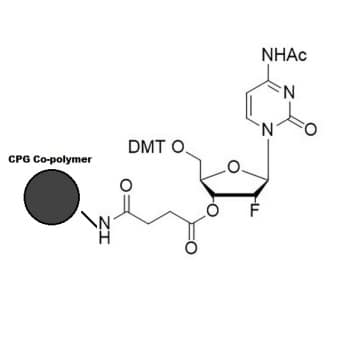
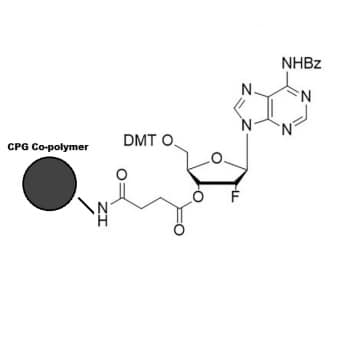
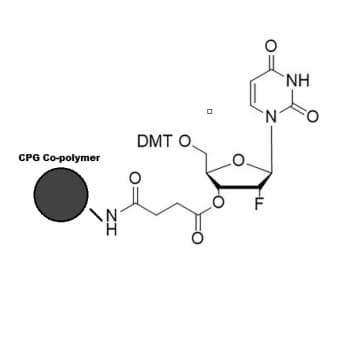
2′-F modified HL-CPG (2′-Fluoro modified CPG) means that the first nucleoside attached to our HL-CPG is a 2′-F (2′-fluoro)–modified nucleoside.
For oligonucleotide drug manufacturing, if the first nucleotide of the sequence requires a 2′-F modification at the start of the sequence, then a 2′-F nucleoside modified solid support is required for synthesis process.

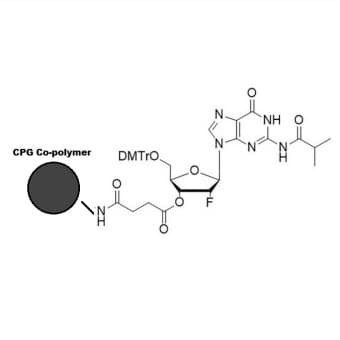
Stucture of 2'-F CPG (Co-Polymer)

The 2′-F modified HL-CPG typically consists of:
Co-polymer coated CPG solid support (available in 500 Å, 1000 Å, or 2000 Å pore sizes)
Silanized functional linker group
2′-F starting nucleoside as linker (2′-F-A, 2′-F-C, 2′-F-G, or 2′-F-U)

Co-Polymer Coated CPG

2'-F Modified Controlled Pore Glass - Co-Polymer

2′-F modified CPG(Co-Polymer) = 2′-F nucleoside linker + functionalized HL-CPG

OUR PRODUCT

Superior Advantages of our HL-CPG (Co-Polymer Coated CPG Solid Support)

By utilizing our HL-CPG, users typically achieve a 30–70% reduction in cost of goods (COG) compared with conventional functionalized CPG, thanks to its high loading capacity, superior purity, and overall process efficiency

High Loading

3–6× higher loading than traditional CPG supports — e.g., our 2000Å HL-CPG achieves 160 μmol/g

High Purity

Delivers >80% oligo purity, owing to strong chemical resistance to reagents and solvents

No Swelling

Unlike traditional polystyrene supports, our HL-CPG remains stable and does not swell under reaction or heating conditions, ensuring consistent synthesis performance

High surface reactivity

The ps layer provides high surface reactivity, resulting in outstanding synthesis performance even when no LCAA is coupled.

No Silica Contamination

No glass particles are generated during ammonolysis, thanks to the PS surface crosslinked with the CPG core structure, ensuring cleaner synthesis and easier purification.

Fully Compatible Setup

Fully compatible with existing CPG-based synthesis setups — no equipment modification required

Main Function of 2'-F Modification on Nucleotides

Enhanced Nuclease Stability

Mechanism of Degradation

Natural RNA possesses a hydroxyl group (-OH) at the 2′ position. This group is easy to attack by endonucleases and exonucleases, which utilize the 2′-OH to facilitate the hydrolysis of the phosphodiester backbone, and result in the rapid degradation of RNA in blood or cells.

Role of 2'-F

The 2′-F is replaced by a chemically more inert fluorine atom -F. The fluorine atom is small and a strong electron-withdrawing group.
Alters Polarity: It affects the electron density distribution of adjacent chemical bonds and the entire ribose ring. Consequently, it changes the nucleotide’s polarity, influencing its hydration and interaction with the solvent (water) in solution.

Blocks Enzyme Action

By eliminating the 2′-OH group, it prevents nuclease-mediated hydrolysis, significantly increasing the oligonucleotide’s half-life in a biological environment.

Conformation Locking Ribose Conformation

The introduction of the fluorine atom, through both steric and electronic effects, strongly biases the ribose ring toward the C3′-endo conformation.

Impact on Binding

This stable, locked conformation allows the 2′-F modified oligonucleotide to better form a double helix structure with its complementary RNA target. This leads to:Increased Affinity: Higher affinity of the oligonucleotide for its target Kd value, higher Tm value).Enhanced Therapeutic Efficacy: For therapeutics, this means aptamers can bind target proteins more tightly, or ASOs can more effectively bind target mRNA.

We provide 2′-F-A (Bz), 2′-F-C (Ac), 2′-F-G (ibu), and 2′-F-U.

Yes. We ensure that both the pore size and particle size are tightly controlled and uniformly distributed. These specifications are fully documented in our COA.

Yes. We have tested our HL-CPG in the synthesis of a 170-nt RNA oligonucleotide and obtained excellent performance results.

Our current monthly delivery capacity is around 500 grams, and we are actively investing in additional equipment to further increase our production capacity.

Get an Instant Quote Now

detracto

Related Product

Custom modifications of our co-polymer coated controlled pore glass, such as DNA/RNA modified HL-CPG, 2′-O-Methyl modified, reverse functionalized, LNA modified, 2′-F modified, and others, are typically available upon request.

Get an Instant Quote Now

Test the power of our Super Solid Support - HL-CPG

Would you like to test our next-generation co-polymer coated CPG? Get in touch with us right now; we offer a free sample of our HL-CPG with unylinker for rapid testing.

Scroll to Top