Nucleic acid monomers refer to the most fundamental structural units that make up DNA and RNA – nucleotides, which are composed of nitrogenous bases, pentose sugars, and phosphate groups, and are linked by phosphodiester bonds to form nucleic acid chains. In all, Nucleic acid monomers = nitrogenous bases+pentose sugars+phosphate groups
Nucleoside= a nitrogenous base + a pentose sugar.
Nucleotide = Nucleoside + ≥ 1 phosphate group

Nucleic Acid Chemical Formulas
Chemical Formulas of Pentose Sugars
1) First, D-ribose is a pentose sugar (five-carbon sugar) with the chemical formula: C₅H₁₀O₅. In RNA nucleotides, both the 2′ and 3′ positions have –OH groups, making RNA more reactive and easily hydrolyzed. Due to this instability, RNA is suitable for short-term gene regulation.
2) 2-deoxy-D-ribose is also a pentose sugar, with the chemical formula C₅H₁₀O₄, present in DNA nucleotides. Its 2′ position has only a hydrogen (H) instead of –OH, hence “2-deoxy” indicates that the second carbon lacks an oxygen atom. DNA is therefore more stable, making it suitable for long-term genetic information storage.
Chemical Formulas of the Five Nitrogenous Bases
| Base | Abbreviation | Chemical Formula | Structure |
|---|---|---|---|
| Adenine | A | C₅H₅N₅ | Double-ring (purine) |
| Guanine | G | C₅H₅N₅O | Double-ring (purine) |
| Cytosine | C | C₄H₅N₃O | Single-ring (pyrimidine) |
| Thymine | T | C₅H₆N₂O₂ | Single-ring (pyrimidine) |
| Uracil | U | C₄H₄N₂O₂ | Single-ring (pyrimidine) |
Note: Thymine (T) = Uracil (U) + a methyl group (–CH₃). Therefore, DNA uses T, while RNA uses U.

Phosphate Group Chemical Formula
In nucleotides or other biomolecules, the phosphate group exists as –O–PO₃²⁻ and connects to the 5′ position of the pentose sugar via a phosphoester bond. In DNA/RNA, it forms the 3′–5′ phosphodiester linkage, expressed as –O–P(=O)(O⁻)–O–.
Chemical Formula Differences Between DNA and RNA Nucleotides
DNA Nucleotides (only monophosphate types listed)
| Name | Abbreviation | Chemical Formula |
|---|---|---|
| Deoxyadenosine monophosphate | dAMP | C₁₀H₁₄N₅O₆P |
| Deoxyguanosine monophosphate | dGMP | C₁₀H₁₄N₅O₇P |
| Deoxycytidine monophosphate | dCMP | C₉H₁₄N₃O₇P |
| Deoxythymidine monophosphate | dTMP | C₁₀H₁₅N₂O₈P |
RNA Nucleotides
| Name | Abbreviation | Chemical Formula |
|---|---|---|
| Adenosine monophosphate | AMP | C₁₀H₁₄N₅O₇P |
| Guanosine monophosphate | GMP | C₁₀H₁₄N₅O₈P |
| Cytidine monophosphate | CMP | C₉H₁₄N₃O₈P |
| Uridine monophosphate | UMP | C₉H₁₃N₂O₉P |
Main Types of Nucleic Acids
Classification by Genetic Material
One type contains D-ribose, and the other contains 2-deoxy-D-ribose.
- DNA nucleotides: dA, dG, dC, dT
- RNA nucleotides: A, G, C, U
Classification by Number of Phosphate Groups
The number of phosphate groups affects energy, activity, and biological functions. Each nucleotide can carry 1 to 3 phosphate groups:
- Monophosphate (NMP): e.g., AMP, dCMP, UMP, dTMP. These are the basic building blocks of DNA or RNA chains, forming only phosphodiester bonds → constructing nucleic acid chains, typically serving as structural units.
- Diphosphate (NDP): e.g., ADP, GDP, CDP. Not directly used in nucleic acid synthesis, they act as intermediate forms between energy storage and nucleic acid synthesis.
- Triphosphate (NTP / dNTP): e.g., ATP, GTP, dATP, dGTP. These are the activated monomers for DNA/RNA synthesis, driving enzymatic reactions, protein synthesis, and signal transduction.
Natural and Modified Nucleotides
Natural nucleotides are standard molecules in biological systems, while modified nucleotides are artificially designed for drugs and chemical synthesis.
Natural (Canonical) Nucleotides
| Base | Deoxynucleoside | Phosphate Forms | Chemical Formula |
|---|---|---|---|
| Adenine (A) | dA | dAMP, dADP, dATP | C₁₀H₁₄N₅O₆P |
| Guanine (G) | dG | dGMP, dGDP, dGTP | C₁₀H₁₄N₅O₇P |
| Cytosine (C) | dC | dCMP, dCDP, dCTP | C₉H₁₃N₃O₆P |
| Thymine (T) | dT | dTMP, dTDP, dTTP | C₁₀H₁₄N₂O₇P |
| Adenine (A) | A | AMP, ADP, ATP | C₁₀H₁₄N₅O₇P |
| Guanine (G) | G | GMP, GDP, GTP | C₁₀H₁₄N₅O₈P |
| Cytosine (C) | C | CMP, CDP, CTP | C₉H₁₃N₃O₇P |
| Uracil (U) | U | UMP, UDP, UTP | C₉H₁₂N₂O₉P |
Modified Nucleotides
There are four main types of modifications:
1. Sugar Modifications
- 2′-O-Methyl (2′-OMe): Adds a methyl group to the 2′ hydroxyl of ribose → increases nucleic acid stability and RNase resistance
- 2′-Fluoro (2′-F): Introduces fluorine at the 2′ hydroxyl → enhances RNA stability and hydrophilicity
- 2′-O-Ethyl (2′-O-Et): Similar to 2′-OMe, commonly used for ASO modifications
- LNA (Locked Nucleic Acid): Locks the ribose ring, increasing oligonucleotide rigidity → improves base pairing affinity
2. Backbone Modifications
- Phosphorothioate (PS): One oxygen in the phosphate backbone is replaced by sulfur → improves RNase resistance and plasma stability
- Methylphosphonate: Increases hydrophobicity and modulates pharmacokinetics
3. Base Modifications
- 5-Methylcytosine (5-methyl-C): Enhances base pairing stability
- Isomeric bases / protective groups → used to protect reactive sites during solid-phase synthesis
- Functionalized bases (fluorescent labels, crosslinkers) → used for experimental detection and molecular labeling
4. End / Special Modifications
- 5′ or 3′ terminal modifications: e.g., Cy3, Biotin, GALNAC, Cholesterol
- Purpose: improve del
Functions and Applications of Nucleotides
Storage and Transmission of Genetic Information
Nucleotides are the basic building blocks of DNA and RNA, serving as essential units for extending DNA and RNA chains.
- DNA replication: Due to DNA’s chemical stability, it can store genetic information long-term and replicate it accurately in daughter cells. The complementary base pairing of nucleotides ensures precise transmission of genetic information, while the sugar-phosphate backbone maintains the stability of the DNA double helix.
- RNA transcription and translation: Nucleotides connect via phosphodiester bonds to form RNA chains. The nucleotide sequence directly determines RNA’s function and target recognition. RNA acts as the carrier of genetic information (mRNA), executor of protein synthesis (tRNA, rRNA), regulator of gene expression (miRNA, lncRNA), and even functions as catalytic ribozymes.
Energy and Metabolic Regulation
1) Energy Metabolism
Nucleotides provide the energy necessary for cells to maintain basic metabolism and growth, playing a central role in systemic energy cycles. Key nucleotides such as ATP, GTP, UTP, and CTP act as mobile energy carriers:
- ATP: Provides energy for metabolic reactions, including muscle contraction, ion pump activity, and metabolite transport.
- GTP: Supplies energy for protein synthesis and signal transduction (e.g., G-protein activation).
2) Activated Intermediates for Biosynthesis
Nucleotides also serve as activated intermediates for macromolecular synthesis:
- UDP-glucose → carbohydrate synthesis and glycoprotein modification
- CDP-diacylglycerol → phospholipid synthesis for constructing cell membranes
- S-adenosylmethionine (SAM) → methylation reactions, regulating protein and DNA modifications
3) Signal Regulation
Nucleotides can be converted into signaling molecules:
- cAMP, cGMP → participate in cell signaling, regulating metabolism, hormone responses, and blood pressure
- ppGpp → regulates bacterial growth rate under stress conditions
4) Precursors and Metabolic Control
Nucleotides are precursors for nucleic acids and cofactors. NAD⁺, FAD, CoA, and other cofactors are derived from nucleotides. Insufficient nucleotide supply can limit DNA, RNA, and protein synthesis.
Applications in Medicine and Biotechnology

PCR, qPCR, and NGS
Nucleotides, as building blocks of DNA, are essential for PCR, qPCR, and NGS:
- PCR: Amplifies specific DNA sequences from trace amounts, commonly used in pathogen detection, gene cloning, mutation analysis, and forensic DNA analysis.
- qPCR: Similar to PCR, but includes fluorescent probes or dyes for real-time quantification, used in gene expression analysis and pathogen load detection.
- NGS: Core technology relies on nucleotide incorporation and signal detection to sequence millions to billions of DNA fragments, used in whole-genome sequencing, transcriptomics, mutation profiling, and single-cell sequencing.
mRNA Vaccines
mRNA vaccines deliver pathogen antigen information directly to cells, allowing the body to synthesize antigen proteins and activate humoral and cellular immunity. mRNA is composed of four nucleotides (A, U, C, G) connected via 3′–5′ phosphodiester bonds. Modified nucleotides (e.g., 1-methylpseudouridine or 2′-O-methyl nucleotides) are commonly used to ensure sufficient mRNA stability and persistence for robust antigen production. Additionally:
- 5′ m7G cap → promotes ribosome recognition and translation
- 3′ poly(A) tail → enhances mRNA stability
ASO, siRNA, and gRNA Drugs
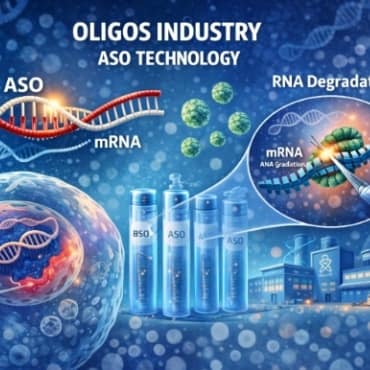
- ASO (Antisense Oligonucleotides): Complementary binding to target mRNA to block or degrade specific transcripts, regulating gene expression.
- siRNA (Small Interfering RNA): Targets and degrades specific mRNA through RNA interference (RNAi), inhibiting protein synthesis.
- gRNA (Guide RNA): In CRISPR-Cas systems, guides Cas proteins to recognize and cut specific DNA sequences for gene editing.
Nucleotides are the fundamental building blocks of ASO, siRNA, and gRNA. Their sequences determine ASO/siRNA target specificity and ensure gRNA accurately guides Cas proteins for DNA cleavage in CRISPR systems.
What Are Oligonucleotides
Oligonucleotides (oligos) are short chains of nucleotides connected together. They are commonly used as primers, probes, or drug molecules. Typically, short oligos such as ASO and siRNA are under 30 nucleotides (nt), while gRNAs are around 100–120 nt. Any chain within roughly a hundred bases is generally referred to as an oligonucleotide.
Significance of Nucleotides in Oligonucleotide Drugs
Nucleotides are the basic structural units of oligonucleotide drugs. Their sequences determine the drug’s pairing ability with target RNA or DNA. The number and arrangement of nucleotides affect drug activity:
- ASO: typically 15–25 nt
- siRNA: typically 20–30 nt
In oligonucleotide drugs, nucleotide sugars and bases define drug properties, while phosphate backbone modifications enhance nuclease resistance and influence effective duration. Overall, nucleotides not only form the chain but also, through sugar, base, and phosphate backbone modifications, affect stability, targeting, nuclease resistance, and bioactivity—making them the core foundation for drug design and optimization.
Why Long-Chain Oligonucleotides Are the Future
With increasing complexity of disease mechanisms and the demand for precise therapy, long-chain oligonucleotides (>100 nt) are becoming a key trend in nucleic acid drugs and gene editing. Many modern diseases (genetic disorders, cancers, neurodegenerative diseases) involve multiple genes, mutations, and complex RNA structures. Short oligos (20–30 nt) may fail to fully cover complex RNA or DNA targets, causing incomplete targeting or off-target effects. Long-chain oligos can:
- Cover the full target sequence, avoiding incomplete binding that could lead to therapeutic failure
- Reduce off-target effects, improving safety and efficacy
- Support multifunctional designs, e.g., one strand regulating multiple mRNAs or providing multiple CRISPR guides
Types of Next-Generation Long-Chain Oligonucleotides
To address complex diseases, long-chain oligonucleotides are increasingly necessary to ensure efficacy and safety, such as:
- mRNA vaccines: encoding full-length antigens or multi-antigen combinations
- Gene editing tools: long gRNA or modified RNA fragments
- Long-chain ASO / siRNA: targeting complex RNA structures for precise gene regulation
Why Modified Nucleotides Are the Future
- Natural nucleotides are easily degraded by nucleases and have short half-lives. Modifications such as phosphorothioate (PS) or 2′-O-methyl (2′-OMe), 2′-fluoro (2′-F) improve nuclease resistance and chemical stability.
- Natural nucleotides may bind non-specifically, causing off-target effects. Modified nucleotides enhance complementarity and affinity for target mRNA or DNA, reducing side effects and improving precision of ASO, siRNA, and gRNA drugs.
- Long-chain oligos (gRNA, long ASO, mRNA fragments) are prone to degradation and misfolding. Modifications protect structure, ensuring translation efficiency and functional integrity.
- Natural nucleotides can trigger innate immune responses. Modified nucleotides (e.g., Ψ, m1Ψ) reduce Toll-like receptor (TLR) recognition, enhancing safety for in vivo long-term or high-dose applications.
Impact of Solid Supports (CPG) on Nucleotide Yield and Purity
In solid-phase oligonucleotide synthesis, Controlled Pore Glass (CPG) acts as the nucleotide carrier. Its properties directly affect yield, purity, and chain length.
CPG Pore Size
| Pore Size | Suitable Oligonucleotide Length |
|---|---|
| ~500 Å | Short oligonucleotides (~20–50 nt) |
| 1000 Å | Longer oligonucleotides (50–100 nt) |
| 2000 Å | Long-chain oligonucleotides (100–200 nt) |

Loading Capacity
Higher nucleotide loading allows more nucleotides to be coupled per cycle, increasing total yield. Loading capacity is a key factor influencing crude product measurement (A260 OD) in nucleotide synthesis.
Impurity Factors
CPG solid support greatly influences oligonucleotide purity. Factors include:
- Silicon elements from CPG dissolving into solvents, increasing impurities
- Structural heterogeneity and pore volume irregularity causing incomplete or incorrect coupling, leading to N-X byproducts
- Larger surface area increases contact, raising the likelihood of side product formation
New Patented Co-Polymer Coated CPG

PoresynSolutions‘ patented co-polymer coated CPG (Polystyrene + CPG) is a next-generation solid support designed to revolutionize oligonucleotide synthesis. Switching to our carrier can substantially boost yields while reducing purification costs by over 30%.
- 3–6× Higher Loading Capacity: 500Å (240 μmol/g), 1000Å (180–200 μmol/g), 2000Å (160–180 μmol/g), enabling longer or higher-density oligonucleotide synthesis.
- Superior Crude Purity (>80%): Chemically inert under all synthesis and post-synthesis conditions, ensuring clean and consistent products.
- No Swelling: Maintains stability under all reaction and heating conditions, supporting reliable scale-up.
- Elimination of CPG Fragmentation: Avoids silica contamination and pipeline clogging, improving workflow efficiency.
Designed for seamless integration, our CPG works with existing synthesis setups with no hardware modifications needed. Contact us to request a sample or a brief discussion to explore how our co-polymer CPG can optimize your oligonucleotide workflows.